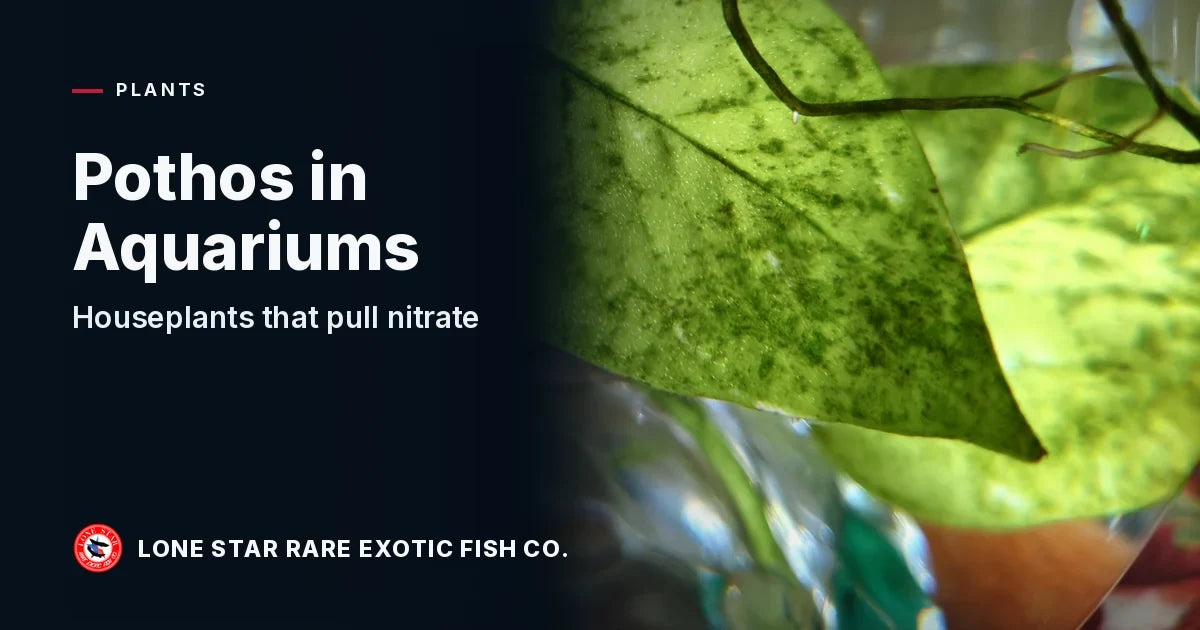
Pothos in aquarium setups has become a fish-room staple for good reason. You drop a few cuttings into the back of a tank or a hang-on-back filter, roots in the water and leaves in the room, and the plant feeds on the same nitrate your fish produce. It's cheap, it's hard to kill, and it works in tanks where fish would eat or uproot regular aquarium plants.
It's not magic, though, and done carelessly it can poison invertebrates or rot in the tank. Here's how houseplant roots in the water actually help, what to expect, which plants work, and the mistakes that cause trouble.
Why houseplant roots in a tank pull nitrate
In a cycled tank, the biofilter turns ammonia into nitrate, and nitrate builds up until something removes it. See The Aquarium Nitrogen Cycle for how that works. Water changes are the main way out. Plants are the other.
Nitrate is relatively harmless to fish and is the preferred form of nitrogen for many crop plants, and aquaponic farms are built on that idea. Fish waste is converted to nitrate, and plant roots take it up, which cuts down how much water has to be exchanged (SRAC 454). A houseplant with its roots in your tank is a very small version of the same system.
Emergent houseplants have one big advantage over submerged aquarium plants. Their leaves are in the air, so they get CO₂ from the room and light from a window or the tank light without competing for either underwater. Fish that would shred or uproot submerged plants can't reach the leaves.
What to expect from pothos in aquarium setups
Be realistic. A couple of cuttings in a heavily fed tank won't keep nitrate down by themselves. Plants remove nitrogen only as fast as they grow, and a houseplant grows a lot more slowly than a crop of lettuce in an aquaponic raft. Plants help most when:
- there's a lot of plant relative to the fish load,
- the plant gets good light and is actively putting out new leaves and roots, and
- you keep doing regular water changes. The plants just slow how fast nitrate climbs between them.
Test nitrate before you add plants and again after a few weeks of growth. That tells you what they're actually doing in your tank. Our nitrate guide covers targets, the units trap on test kits and how to work out a water-change schedule.
Setting up pothos in a fish tank
- Start with cuttings, not a potted plant. Take a stem section with at least one or two nodes, the bumps where leaves meet the stem. That's where roots grow.
- Get rid of all the soil. If you use rooted pieces, wash every bit of potting mix off the roots. Soil and fertilizer don't belong in your tank.
- Keep the leaves out of the water. Only the roots and the bare stem near the nodes should be wet. Submerged leaves rot.
- Anchor the stems. Tuck them in a hang-on-back filter, a plant basket on the rim, a suction-cup clip, or the gap at the back of the lid. A filter outflow chamber works well because water flows constantly past the roots.
- Give the leaves light. Pothos tolerates low light, but it grows faster, and pulls more nitrate, in brighter indirect light.
- Trim and thin. Cut back long vines, and pull out any roots that turn brown and mushy. Rotting roots release ammonia (see our ammonia guide).
Big tanks and big fish
Large, hungry fish will tear dangling roots apart, and some will eat them. On tanks with fish that dig, graze or bite at anything moving, keep roots inside the filter, a sump or a screened basket where fish can't reach them. A sump or refugium is the best home for houseplants on a big system. You get a lot of root mass and none of it in harm's way.
The pesticide problem
This is the risk to take seriously, especially in a tank with shrimp. Nursery and big-box houseplants may have been treated with systemic insecticides. Plants take these up from the soil or through the leaves and move them through their tissues (NPIC), so rinsing the roots won't remove them. One major class, the neonicotinoids, is highly toxic to aquatic invertebrates. A review of lab toxicity tests on 49 species of aquatic insects and crustaceans recommended keeping neonicotinoids in natural waters below 0.2 µg/L for short-term exposure and below 0.035 µg/L for long-term exposure, to protect wild aquatic invertebrate communities (Morrissey et al. 2015, Environment International). Those are parts per billion. They're environmental "stay below" benchmarks for wild waters, not tested aquarium limits and not fish limits, and no one has measured how much a nursery cutting releases into a tank. But they show how little it takes to affect sensitive invertebrates.
In a home aquarium, shrimp are the animals to worry about. In the review, aquatic insect larvae were the most sensitive, and crustaceans, the group shrimp belong to, were generally less sensitive but not always. Snails weren't part of the review. One lab study on Neocaridina shrimp, the cherry shrimp group, found that imidacloprid, the most common neonicotinoid, significantly cut their movement within a day at 31 µg/L, the lowest level tested, and halved their activity at about 510 µg/L over 4 days. Those levels are still far above the thresholds, but they show shrimp are affected well below lethal doses (Siregar et al. 2021, Antioxidants). Fish are far less sensitive still. The 96-hour LC50 of imidacloprid is 211 mg/L for rainbow trout, about a million times the short-term threshold above (EXTOXNET).
To reduce the risk:
- Get cuttings from a known, untreated plant, like a friend's long-established houseplant, rather than a new nursery pot.
- Ask the nursery whether the plant was treated with a systemic insecticide. Some tags say so, but no tag doesn't mean untreated.
- Grow new cuttings in a jar of plain water for several weeks and change the water often before they go in a tank. This is common practice. It reduces the risk but doesn't guarantee a plant is clean.
- Never add fertilizer, leaf shine or plant food to a plant whose roots sit in your tank.
Other houseplants that work, and some that don't
| Plant | How it does with roots in water | Notes |
|---|---|---|
| Pothos (Epipremnum) | Excellent | The standard. Fast rooting, very tolerant. |
| Philodendron (heartleaf types) | Good | Similar to pothos, a little slower |
| Arrowhead vine (Syngonium) | Good | Roots readily from cuttings |
| Lucky bamboo (Dracaena sanderiana) | Good | Keep leaves above water |
| Monstera (cuttings) | Fair | Large, slow, needs space above the tank |
| Peace lily (Spathiphyllum) | Mixed | Roots can rot if permanently submerged in warm water. Keep only the root tips wet. |
| Spider plant | Mixed | Same caveat as peace lily. Listed by the ASPCA as non-toxic to cats and dogs. |
| Aluminum plant (Pilea cadierei) | Skip | Not a proven roots-in-water plant |
Whatever you use, keep the crown and leaves dry, and pull anything that starts to rot.
A warning for pet owners
Pothos, philodendron, peace lily, monstera and arrowhead vine all contain insoluble calcium oxalate crystals. If a cat or dog chews the leaves, it can cause painful mouth irritation, drooling and vomiting (ASPCA; Merck Veterinary Manual). Lucky bamboo is a Dracaena, which the ASPCA also lists as toxic to cats and dogs for a different reason (saponins). It can cause vomiting and drooling (ASPCA). Vines trailing from the top of a tank are right at chewing height for a curious cat. Keep them trimmed and out of reach.
Where plants fit in your maintenance
Plants are a supplement. They lower the rate at which nitrate builds, they soak up some phosphate, and many keepers like the look. They don't remove ammonia faster than a healthy biofilter, and they don't replace water changes, which also remove dissolved organics and restore minerals. To size those changes properly, work out your tank's true water volume. Top off evaporation with treated tap water. Our tap water guide explains why every top-off needs conditioner too.
If you're planning a tank around fish that need very clean water, plan for water changes first and plants second. Then browse what's in stock now.
FAQ
Is pothos safe for fish?
Generally, yes, if the leaves stay out of the water and the plant hasn't been treated with systemic insecticides. Rinse all soil off and remove any rotting roots.
How much pothos do I need to lower nitrate?
More than most people expect. Plants remove nitrate only as fast as they grow. A few cuttings slow the rise between water changes. A sump full of roots can make a measurable difference. Test before and after.
Can pothos roots hurt shrimp?
The roots themselves aren't the concern. Possible pesticide residue from treated nursery plants is. Use cuttings from untreated plants, and pre-grow new cuttings in plain water. If you keep shrimp, you can also run new cuttings on a fish-only tank or sump for a few weeks first. That's a precaution, not a test.
Should the leaves be underwater?
No. Only the roots and bare stem near the nodes should be submerged. Underwater leaves rot.
Do aquarium plants replace water changes?
No. Plants slow nitrate buildup but don't remove other wastes or restore minerals. Keep up regular water changes.
Cover photo (cropped): Dr. Chinchu C. / Wikimedia Commons, CC BY 4.0