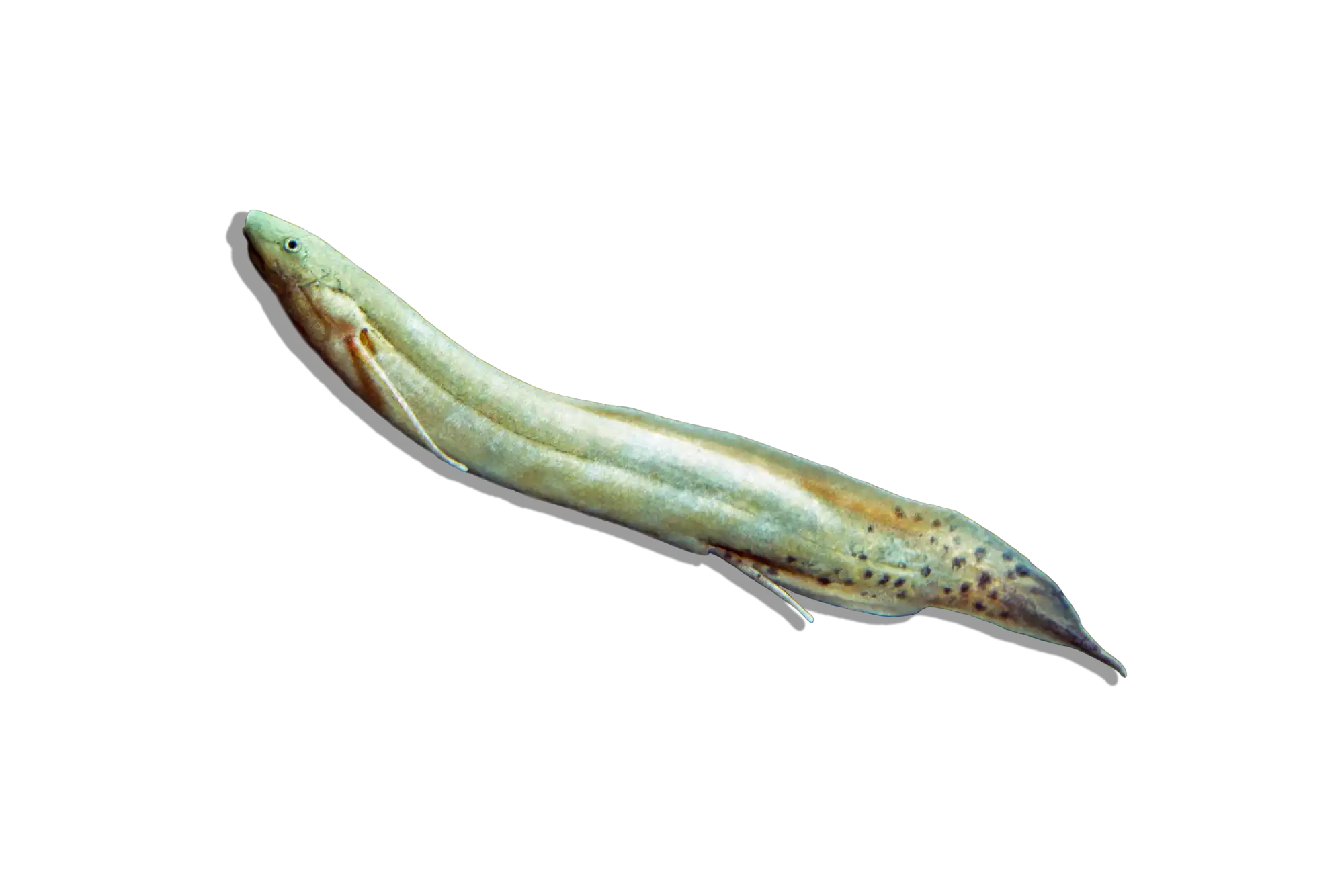
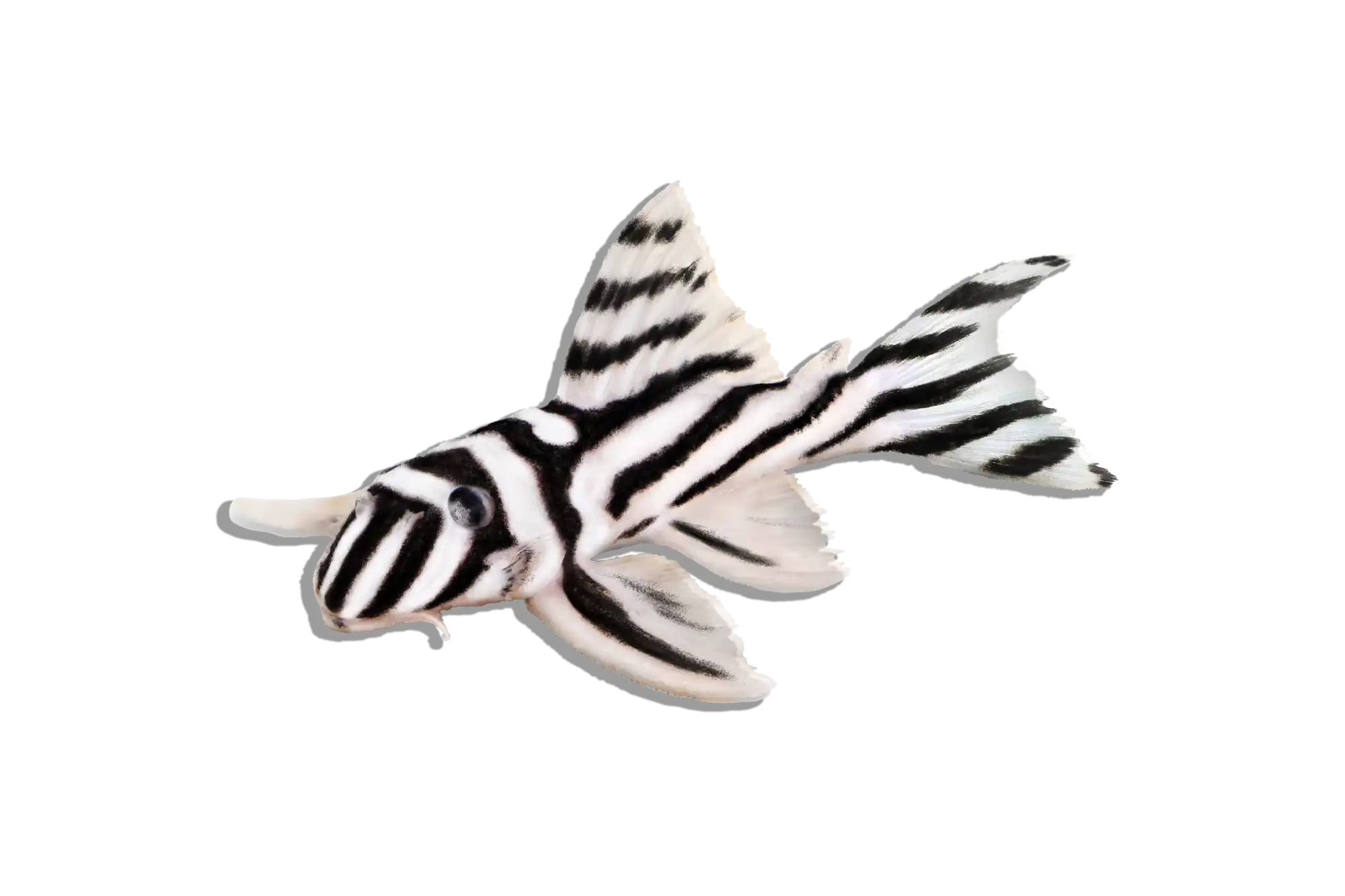
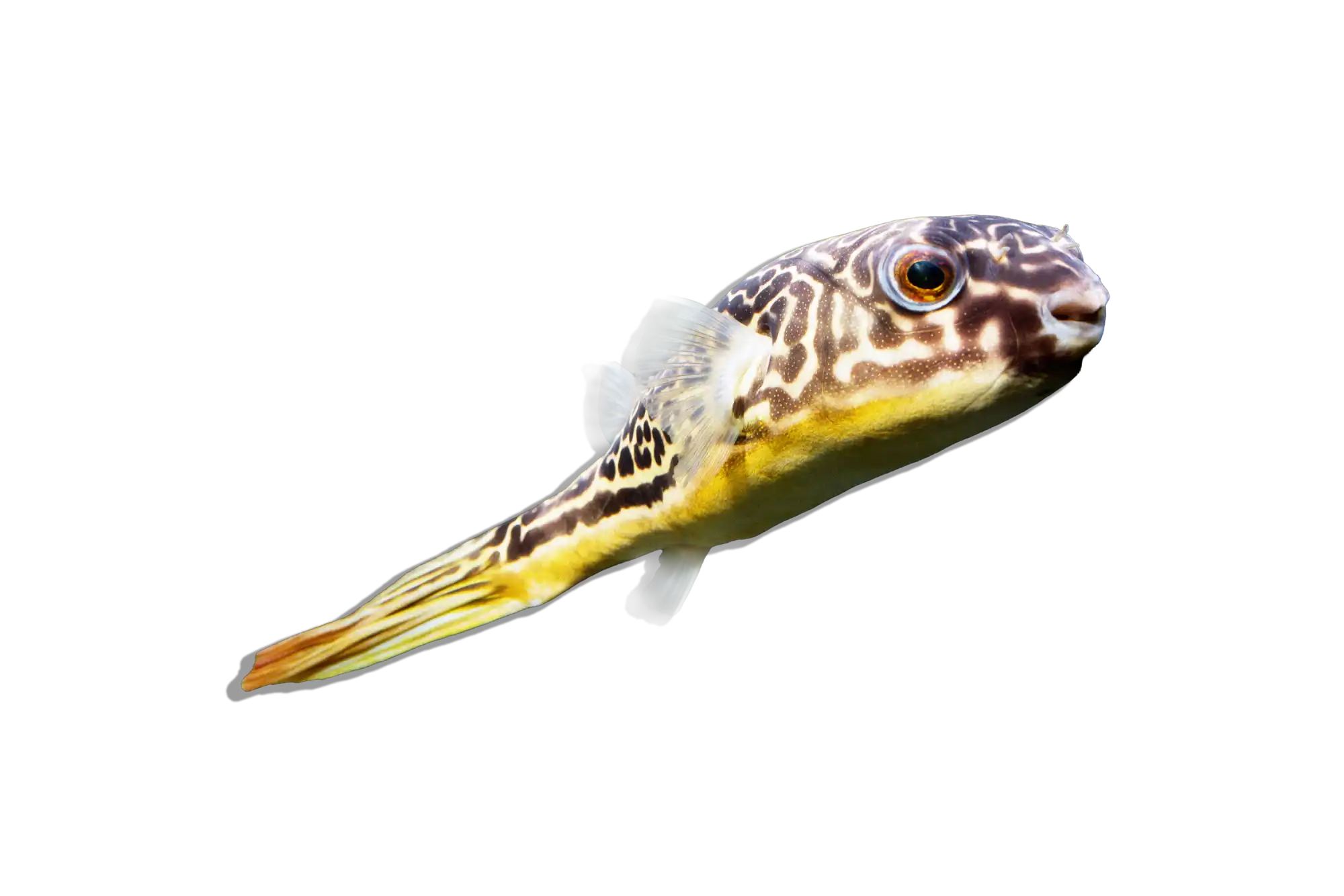
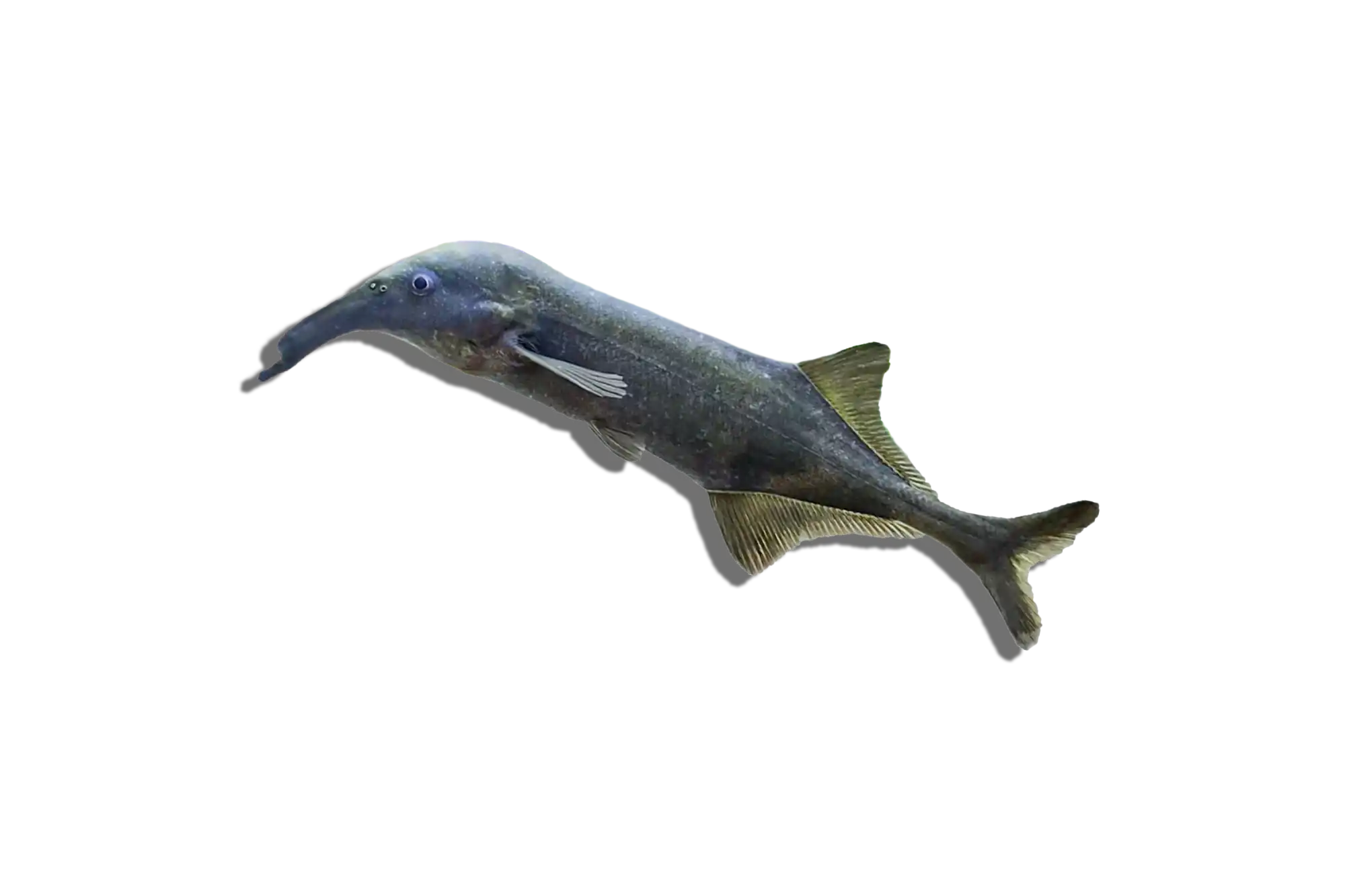
Blue Eye Suttoni Pleco (Panaque cochliodon)
Also sold as: Blue-Eyed Pleco, Blue-Eyed Royal Pleco [1][3]
Family: Loricariidae (armored suckermouth catfishes) [2]
Size offered: 12–14" [7]
The body is plain dark grey with no royal-style pinstripes, and the eye is a vivid blue, the feature behind all of its common names [1][3]. It is a heavy-bodied Panaque with prominent cheek (interopercular) spines [3].
Which fish is this?
For decades the hobby sold this fish as Panaque suttoni, and that name is still on many listings, including older versions of ours. It's a misidentification. The real Panaque suttoni was described by Schultz in 1944 from the Lake Maracaibo basin in Venezuela. Because it honors both Dr. and Mrs. Sutton, its name is now spelled Panaque suttonorum [2]. Schultz's description of P. suttonorum doesn't match the blue-eyed fish, and it comes from a different locality [3].
The blue-eyed fish in the trade is identified as Panaque cochliodon (Steindachner, 1879), described from the Río Cauca, the largest tributary of the Magdalena River in Colombia [1][2][3]. The Catalog of Fishes lists P. cochliodon as a valid species found only in the Cauca and Magdalena basins of Colombia [2]. "Suttoni" survives here only as the familiar trade name.
Natural habitat
Panaque cochliodon lives in the Cauca and Magdalena river systems of Colombia's Caribbean slope [1][2]. Like other Panaque, it lives among fallen trees and tangles of submerged wood [1].
The IUCN Red List assesses P. cochliodon as Near Threatened (assessed 2014, published 2016), because of a suspected decline of about 25% from collection for the aquarium trade and habitat degradation [8].
Size
PlanetCatfish gives a maximum size of 300 mm (11.8") standard length, measured without the tail [1]. ScotCat lists 40 cm (16") without saying how it was measured [3]. Our listing gives an adult size of 16"+ [7]. The size offered is 12–14" [7], so plan the tank for a 16" adult.
Care parameters
| Parameter |
Recommendation |
| Temperature |
67–75°F (20–24°C) [3] |
| pH |
6.5–7.2 [3] |
| Hardness |
Not published; keep it stable and avoid extremes. |
| Tank |
Very large, with a long footprint, lots of wood and caves [3][7] |
| Filtration |
Strong filtration with good water movement [3] |
Our listing recommends 200+ gallons for a fish this size [7]. ScotCat recommends plenty of hiding places, frequent water changes and powerful filtration, because wood-eating produces a lot of waste [3].
Diet: it eats wood
Panaque are the wood-eating plecos. Their spoon-shaped teeth, wider at the tip than at the base, set the genus apart from other loricariids [1][3]. Schaefer and Stewart (1993) found wood was the only visible material in the guts of Panaque and suggested the fish might get energy from it [4]. Later gut studies on two other Panaque species found that wood passes through in a few hours and is poorly digested. Most of the fishes' nutrition seems to come from the soft, decaying wood surface and the microbial film on it, not from the wood itself [5].
In the aquarium:
-
Driftwood is food, not just décor. Keep real, aquarium-safe hardwood in the tank at all times [1].
-
Vegetables: zucchini and cucumber [1][3]; peas and green beans [1].
-
Tubers: potato, yam and similar [1].
-
Prepared foods: sinking algae wafers and tablets [1][3].
Expect plenty of fine wood waste.
Temperament and tankmates
PlanetCatfish describes it as generally peaceful but territorial toward its own kind, so keep one per tank [1]. ScotCat calls it a bit robust [3]. Choose peaceful tankmates that won't compete for caves on the bottom.
Breeding
No spawning in the aquarium has been reported [1].
Restrictions
Hawaii: the Hawaii Department of Agriculture's Conditionally Approved list names the blue-eyed pleco under its old name, Panaque suttoni. Animals on that list need an import permit from the Plant Quarantine Branch before they can be shipped to Hawaii [9].
Maine: Maine's Unrestricted Species List names the blue-eye panaque as Panaque suttonorum, not P. cochliodon. Check with Maine Inland Fisheries & Wildlife before ordering [10].
If you're unsure, check with your state wildlife agency before you buy.
Sources
- PlanetCatfish, Cat-eLog: Panaque cochliodon (Steindachner, 1879). https://www.planetcatfish.com/common/species.php?species_id=2295
- Fricke, R., Eschmeyer, W. N. & Van der Laan, R. (eds). Eschmeyer's Catalog of Fishes: Genera, Species, References, species entries for Panaque cochliodon (Steindachner 1879), Chaetostomus cochliodon gibbosus Steindachner 1880 (synonym) and Panaque suttoni Schultz 1944 = P. suttonorum. California Academy of Sciences. https://researcharchive.calacademy.org/research/ichthyology/catalog/fishcatget.asp?tbl=species&genus=Panaque (accessed Oct 16, 2026).
- ScotCat, Ident-A-Cat: Panaque cochliodon (Steindachner, 1879). https://www.scotcat.com/loricariidae/panaque_cochliodon.htm
- Schaefer, S. A. & Stewart, D. J. 1993. Systematics of the Panaque dentex species group (Siluriformes: Loricariidae), wood-eating armored catfishes from tropical South America. Ichthyological Exploration of Freshwaters 4(4): 309–342.
- German, D. P. 2009. Inside the guts of wood-eating catfishes: can they digest wood? Journal of Comparative Physiology B 179(8): 1011–1023. https://doi.org/10.1007/s00360-009-0381-1
- Steindachner, F. 1879. Original description of Chaetostomus cochliodon. Anzeiger der Kaiserlichen Akademie der Wissenschaften, Wien, Math.-Naturw. Classe 16(18): 194 (cited via [2]).
- Lone Star Rare Exotic Fish Co. listing, Blue Eye Suttoni Pleco.
- Jiménez-Segura, L., Mojica, J. & Alonso, J. C. 2016. Panaque cochliodon. The IUCN Red List of Threatened Species 2016: e.T49829660A61473488. https://doi.org/10.2305/IUCN.UK.2016-1.RLTS.T49829660A61473488.en
- Hawaii Department of Agriculture, Plant Quarantine Branch. List of Conditionally Approved Animals (HAR ch. 4-71), Loricariidae: 'Panaque suttoni, plecostomus, blue-eyed'. https://dab.hawaii.gov/wp-content/uploads/2019/08/List-of-Conditionally-Approved-Animals.pdf. Permit requirement: https://dab.hawaii.gov/pi/pq/import-program/pq-non-domestic-animal-and-microorganism-lists/ (accessed Oct 16, 2026).
- Maine Department of Inland Fisheries and Wildlife, Unrestricted Species List (09-137 CMR ch. 7). https://www.maine.gov/ifw/docs/unrestrictedspecies.pdf