This roundup covers news through Wednesday, Oct 14, 2026.
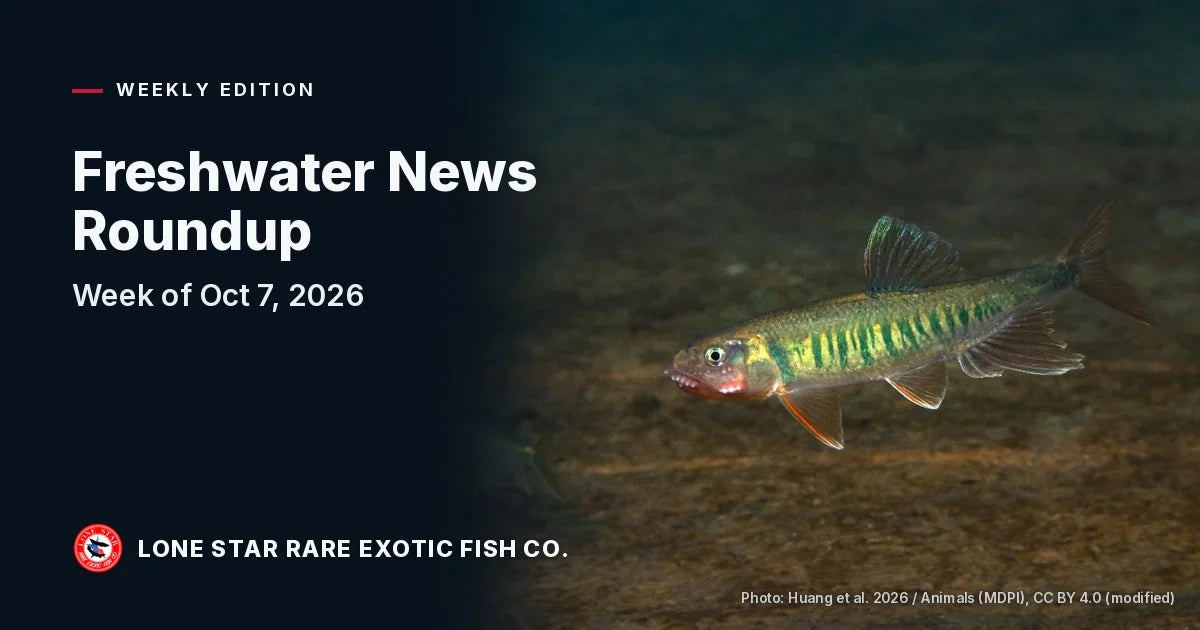
Cover photo: Huang et al. 2026, Animals (MDPI), Fig. 5. CC BY 4.0; modified.
Every Wednesday we pull together what's happened in the freshwater world over the past week: new fish described by science, rule changes that touch the hobby across the US, weather that affects your fish or your shipments, and events worth putting on the calendar. This week there were plenty of new species to go around, including three new annual killifish, four African suckermouth catfish and a pair of leaf-litter catfish from Brazil. There's also an open Texas comment period, a new trade seal out of Brazil, and the tail end of Hurricane Isaias.
1. Three new annual killifish from temporary pools in Brazil

Killie keepers, this one's for you. On October 12, Neotropical Ichthyology published three new Hypsolebias species: H. baptistai, H. maylermartinsi and H. rosai. Each is known only from its own temporary pool in the upper rio Paracatu drainage, part of the rio São Francisco basin in Paracatu, Minas Gerais. They belong to the H. trilineatus group, whose males show a dark metallic ochre-yellow color on the front of the flank and light-red pectoral fins. The new species are told apart mainly by the males' flank patterns and body proportions. The authors report that parts of two of the pools have already been filled in for soybean fields, and that the third was partly dug out for livestock watering. They suggest listing the species as Critically Endangered.
Sources:
2. Four new suckermouth catfish from the Zambezi

A team from Rhodes University and the South African Institute for Aquatic Biodiversity has split the old "basket" name Chiloglanis neumanni in the Zambezi system and described four new suckermouth catfish: Chiloglanis imberbis, C. shirensis, C. lapidis and C. brevispina. The paper came out in the Journal of Fish Biology on October 14. These are small, current-loving mochokids that cling to rocks with an oral disc. C. imberbis ("beardless") lacks obvious inner mandibular barbels, and C. lapidis ("stone") gets its name from its rough, uniformly brown, rock-like skin. They're not common in the US trade, but they're a good look at how much catfish diversity is still undescribed. The authors also point to a mine-tailings spill that hit more than 100 km of a Kafue River tributary as a sign of how fast these streams can be hurt.
Source: Mutizwa, Ntokoane & Chakona 2026, Journal of Fish Biology
3. Two new leaf-litter catfish from Brazil's Atlantic Forest

On October 13, Wilson Costa and colleagues at the Federal University of Rio de Janeiro described two new pencil catfish, Trichomycterus elegans and T. rioclarensis, in the journal Biology. Both belong to the T. nigroauratus group, small catfish that bury themselves in or swim over leaf litter in fast mountain streams, often below waterfalls, in the Rio Paraíba do Sul basin of southeastern Brazil. T. elegans is the smallest member of the group (the largest known specimen is 56 mm SL) and lives in the upper Rio Paquequer and Rio dos Frades drainages, partly inside Serra dos Órgãos National Park. T. rioclarensis is named for the municipality of Rio Claro. The team also flagged the Serra da Mantiqueira as a hotspot for these catfish and a priority for conservation.
Sources:
4. A new Chinese stream minnow with fiery breeding colors

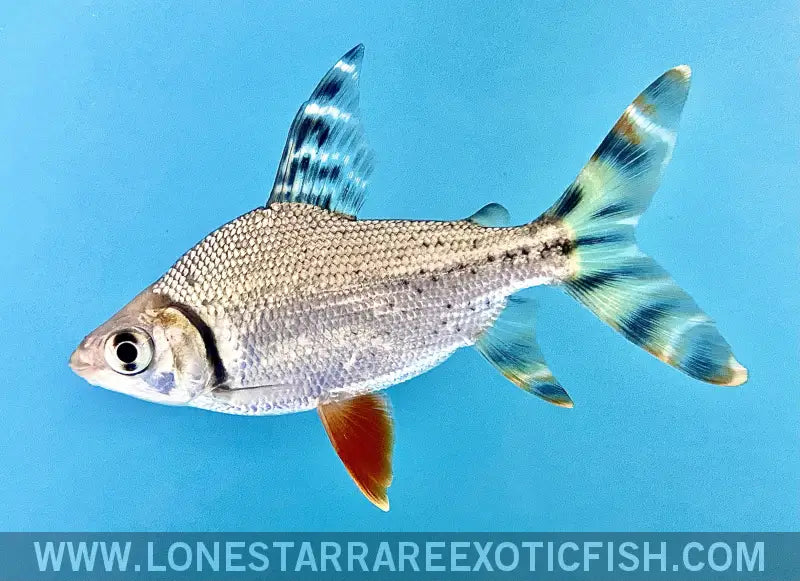
On October 10, Chinese researchers described Opsariichthys baguiensis, a new stream minnow from the Xijiang River system (the middle and upper Pearl River) in Guangxi. The paper appeared in Animals. The fish had been filed under O. minutus, and the study also sinks O. minutus into the widespread O. bidens. Breeding males are striking: orange-red lower jaw and cheeks, pale orange fins and 12 to 18 bluish-green bars on the flank, plus prominent breeding tubercles on the lower jaw and cheek. It lives in clear streams with moderate current, pebble and sand bottoms and dense plants. The authors recommend a formal conservation assessment, since the Xijiang is under growing pressure from hydropower and shipping.
Sources:
5. Texas: TPWD is cleaning up its fisheries rules, comments due Nov 4

Texas Parks and Wildlife is moving the second round of its Texas Regulatory Efficiency Office cleanup, this time covering Chapter 57 (Fisheries) and Chapter 58 (Oysters, Shrimp, and Finfish) of the Texas Administrative Code. The proposals ran in the October 2 Texas Register. The commission is set to vote November 5, and online comments close at 5:00 p.m. on November 4. For hobbyists, the parts to read are the controlled exotic species provisions (§57.113) and the definitions in §57.111. In the published text, those changes mostly swap repeated statutory language for references to the Parks and Wildlife Code. As proposed, the package doesn't add or remove any species from Texas's controlled exotic species list. TPWD says it doesn't create or expand any regulation. Still, if you keep or sell anything near the controlled exotic line in Texas, it's worth reading the text yourself and commenting if something looks off.
Sources:
6. Brazil launches a national "aquarium seal" for the ornamental fish trade

Brazil's Ministry of Fisheries and Aquaculture (MPA) has created the Selo Nacional da Aquariofilia, a national seal for professionals and businesses in the ornamental aquatic supply chain that meet the ministry's requirements. It was set up under Portaria MPA nº 753 (October 5, 2026) and announced October 8. Brazil is a major source of South American aquarium fish, so an official mark for compliant professionals and businesses could eventually help buyers tell well-run supply chains from the rest. The details of who qualifies are in the portaria, and we'll keep an eye on how it rolls out.
Source: Ministério da Pesca e Aquicultura (Portuguese)
7. Shipping: Hurricane Isaias and the Gulf Coast cleanup

Hurricane Isaias made landfall near Destin, Florida, around 8:30 p.m. CDT on Friday, October 9, as a Category 2 storm with 105 mph winds and a central pressure of 971 mb. By Friday afternoon, all ports in Sector Mobile, including Gulfport, Pascagoula, Mobile, Pensacola and Panama City, were closed, and Gulf Coast airports were seeing flight cancellations and reduced cargo capacity. USPS reopened its Pensacola processing and distribution center on October 13, but six delivery locations in Gonzalez, Milton, Pensacola, Shalimar and Valparaiso were still suspended as of that update. If you have fish shipping into or through the Florida Panhandle or southern Alabama this week, build in extra time and keep an eye on tracking.
Sources:
- NHC landfall update
- C.H. Robinson freight advisory (Oct 9)
- USPS Florida business service alerts (see the 10-13-26 entries)
8. Coming up: DFWAA Expo this Saturday, SMAS auction next week

Up in North Texas, the Dallas Fort Worth Aquarium Association EXPO is scheduled for this Saturday, October 17, at Esports Stadium Arlington (1200 Ballpark Way, Arlington). The following Saturday, October 24, the Southeastern Michigan Aquarium Society holds its Fall Auction from 11 a.m. to 5 p.m. at Allen Park Presbyterian Church in Allen Park, Michigan.
Sources:
That's the week. If you spot a story we should be covering, a new species, a rule change in your state, a club show, or a first spawning in your fish room, text us at (936) 628-5577 and it may make next week's roundup. See you next Wednesday.
Lone Star Rare Exotic Fish Co.